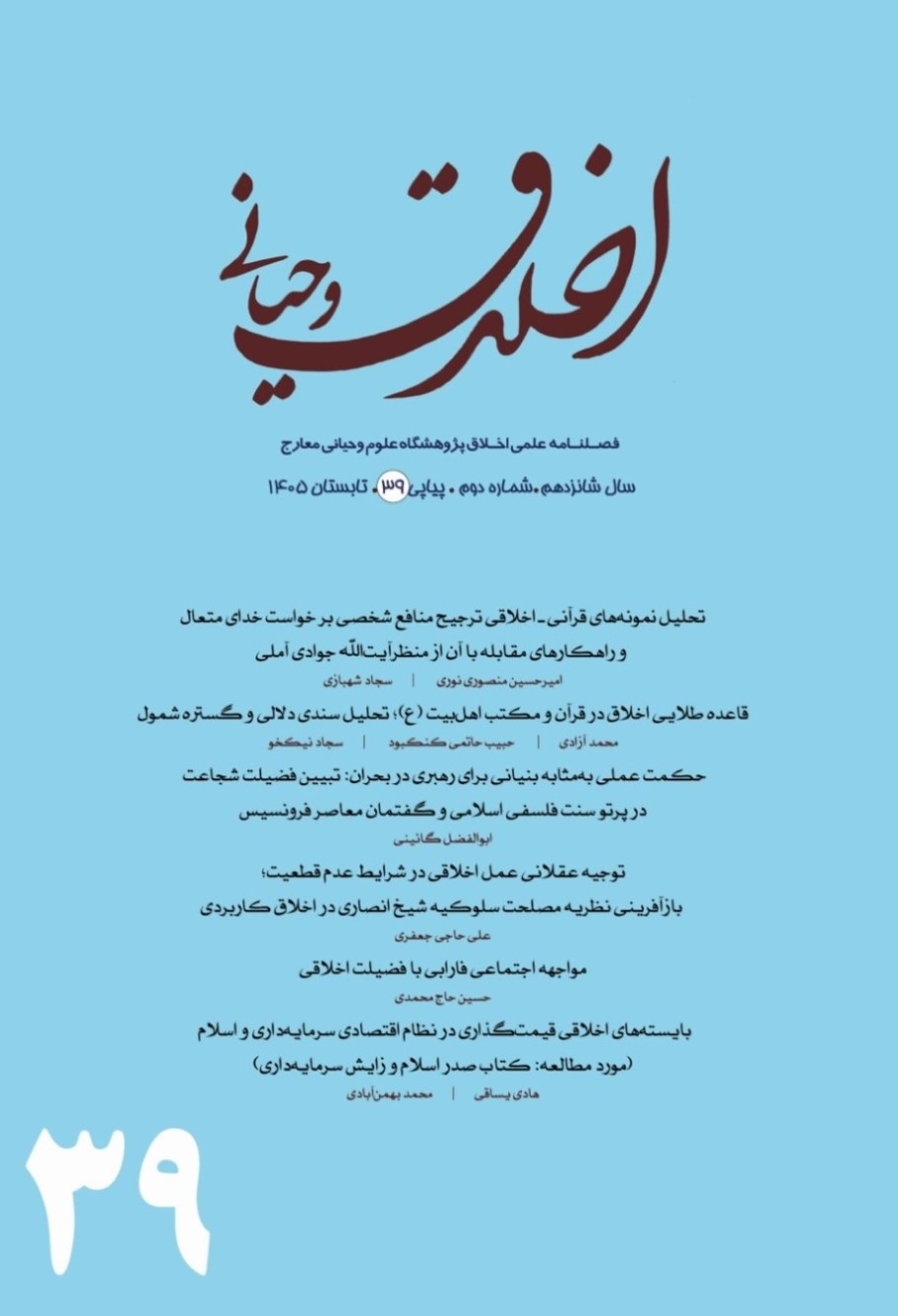
نوع مقاله : مقاله پژوهشی
تازه های تحقیق
Extended abstract
Introduction and Problem Statement:
Al-Farabi regards human happiness (sa‘āda) as contingent upon the realization of virtues, enumerating four distinct categories: rational (nutqiyya), moral/ethical (khuluqiyya), practical/technical (sina‘iyya), and theoretical (nazariyya). There exists an underlying tension between rational virtue (grounded in knowledge) and moral virtue (the manifestation of ethical conduct)—a tension that is resolved only by recognizing “theoretical virtue” as the guiding principle and foundation for the other two. According to Al-Farabi, theoretical virtues are emanated from the Active Intellect (al-‘Aql al-Fa‘‘āl) and their attainment depends upon innate human disposition (fitra); hence, they are neither strictly acquired nor fully voluntary. This gives rise to a fundamental challenge: if theoretical virtue is non-voluntary, is the realization of moral virtue and ultimate happiness equally accessible to all individuals? Adopting a descriptive-analytical approach and drawing upon Al-Farabi’s corpus, this study investigates the conditions of possibility for attaining moral virtue and examines how individual and social limitations are overcome within the framework of the Virtuous City (al-Madīna al-Fādila). While numerous scholars—such as Tabatabaei, Nazerzadeh Kermani, Davari Ardakani, Mohajernia, Sayyah, Tourani, and Haji-Hosseini—have explored Al-Farabi’s political philosophy and theory of virtue from various angles, none have systematically addressed the critical dilemma of attaining theoretical virtue as the bedrock of moral virtue, nor the mechanism for rectifying innate and natural deficiencies in acquiring virtues. The present article seeks to reread and reconstruct the resolution to this problem within Al-Farabi’s philosophical system.
Conceptual Framework:
1. Virtue (Faḍīla): Al-Farabi defines virtue as a psychic disposition (hay’a nafsāniyya) that inclines human beings toward noble deeds, categorizing it into rational, moral, practical, and theoretical virtues. Moral virtue, serving as the “cardinal virtue,” emerges through the habitual repetition of good actions, while theoretical virtue functions as the mediating link between contemplation and ethical character formation.
2. Volition (Ikhtiyār): The realization of moral virtue is actual and Problem Statement:**
Al-Farabi regards human happiness (sa‘āda) as contingent upon the realization of virtues, enumerating four distinct categories: rational (nutqiyya), moral/ethical (khuluqiyya), practical/technical (sina‘iyya), and theoretical (nazariyya). There exists an underlying tension between rational virtue (grounded in knowledge) and moral virtue (the manifestation of ethical conduct)—a tension that is resolved only by recognizing “theoretical virtue” as the guiding principle and foundation for the other two. According to Al-Farabi, theoretical virtues are emanated from the Active Intellect (al-‘Aql al-Fa‘‘āl) and their attainment depends upon innate human disposition (fitra); hence, they are neither strictly acquired nor fully voluntary. This gives rise to a fundamental challenge: if theoretical virtue is non-voluntary, is the realization of moral virtue and ultimate happiness equally accessible to all individuals? Adopting a descriptive-analytical approach and drawing upon Al-Farabi’s corpus, this study investigates the conditions of possibility for attaining moral virtue and examines how individual and social limitations are overcome within the framework of the Virtuous City (al-Madīna al-Fādila). While numerous scholars—such as Tabatabaei, Nazerzadeh Kermani, Davari Ardakani, Mohajernia, Sayyah, Tourani, and Haji-Hosseini—have explored Al-Farabi’s political philosophy and theory of virtue from various angles, none have systematically addressed the critical dilemma of attaining theoretical virtue as the bedrock of moral virtue, nor the mechanism for rectifying innate and natural deficiencies in acquiring virtues. The present article seeks to reread and reconstruct the resolution to this problem within Al-Farabi’s philosophical system.
Conceptual Framework:
1. Virtue (Faḍīla): Al-Farabi defines virtue as a psychic disposition (hay’a nafsāniyya) that inclines human beings toward noble deeds, categorizing it into rational, moral, practical, and theoretical virtues. Moral virtue, serving as the “cardinal virtue,” emerges through the habitual repetition of good actions, while theoretical virtue functions as the mediating link between contemplation and ethical character formation.
2. Volition (Ikhtiyār): The realization of moral virtue is actualdīb*). Instruction, aimed at cultivating theoretical virtues, must be tailored to individual capacities—imparted via strict philosophical demonstration (burhān) for the intellectual elite, and through persuasive and imaginative methods (iqnā‘ and takhyīl) for the general public, who lack the capacity for abstract universal comprehension. Moral discipline is implemented through both persuasion and coercion, wherein appointed educators and moral guardians guide individuals toward happiness according to their respective communal capacities. Thus, through sound education and governance, the ruler of the Virtuous City establishes the necessary conditions for all citizens to attain moral virtue.
Conclusion:
Al-Farabi identifies happiness as the ultimate human end and positions theoretical virtue as the indispensable bridge between intellect and practice. He resolves the tension between individual agency and the transcendent Active Intellect within the social-political matrix of human life. Under the leadership of the philosopher-ruler (Imam), the Virtuous City compensates for innate individual disparities through stratified pedagogy and discipline, thereby rendering the attainment of moral virtue and ultimate happiness possible for all members of society.
عنوان مقاله English
نویسنده English
The present study investigates the conditions of possibility for attaining moral virtue from al-Farabi's perspective. The problem is this: given that the acquisition of theoretical virtues depends upon the Active Intellect and natural disposition, and since these are not equally distributed among human beings, is the realization of moral virtues and the attainment of happiness equally accessible to all? This study adopts a descriptive-analytical approach and draws upon textual evidence from al-Farabi's works, including *Siyāsa madaniyya*, *Fuṣūl muntazaʿa*, and *Ārāʾ ahl al-madīna al-fāḍila*. The findings indicate that al-Farabi's response lies in the social dimension of human existence. In his view, the human being is a political animal, and life's necessities cannot be secured in isolation. Among various political associations, only the virtuous city possesses the characteristic of compensating for natural deficiencies. What distinguishes the virtuous city is its ruler, who occupies the highest rank by nature and possesses superior theoretical and moral virtues. Al-Farabi conceives the ruler as philosopher and Imām—the intermediary through whom the effluence of the Active Intellect descends. Moral perfection operates through both instruction and upbringing. Instruction refers to the cultivation of theoretical virtues and the purification of reason, while upbringing denotes the acquisition of moral virtues through habituation in practical dispositions. Al-Farabi conceives instruction not merely as demonstrative reasoning but also as persuasion, and regards upbringing as achievable through both persuasion and compulsion. In this manner, al-Farabi resolves the tension between free will and the Active Intellect by appealing to the social dimension of human existence.
کلیدواژهها English