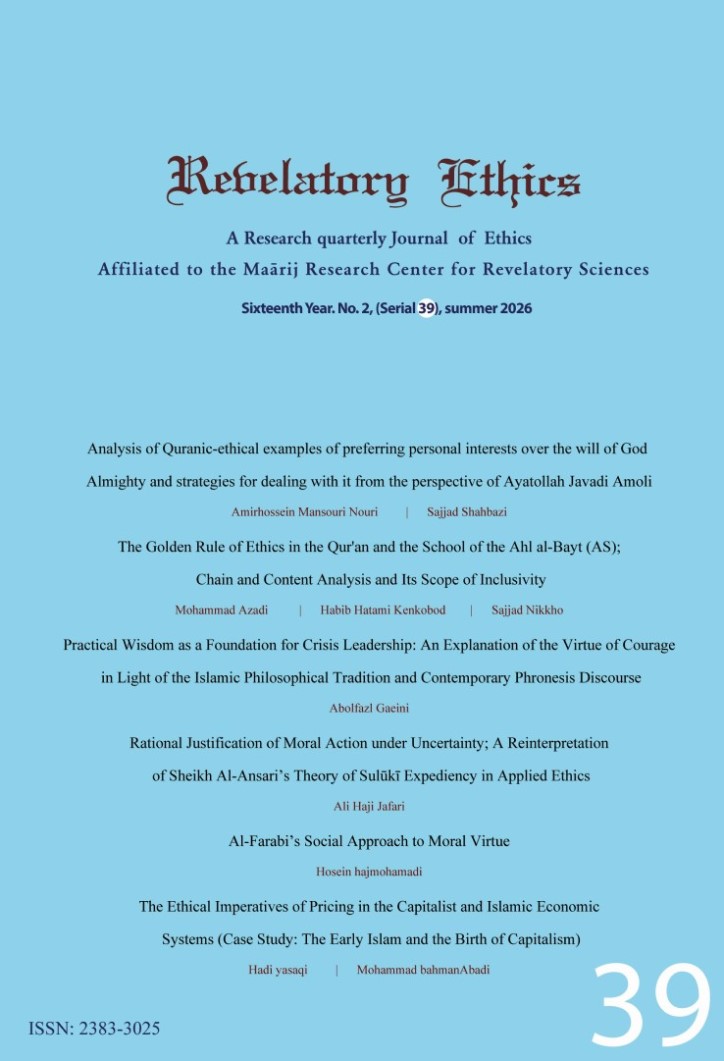
Revelatory Ethics

Revelatory Ethics

Number of Volumes 15
Number of Issues 37
Number of Articles 248
Number of Contributors 355
Article View 276,362
PDF Download 153,871
View Per Article 1114.36
PDF Download Per Article 620.45
Number of Submissions 1,182
Acceptance Rate 16
Time to Accept (Days) 136

Revelatory Ethics is a double-blind, peer-reviewed publication which is published by Maarej Research Institute of Revelation Sciences. This journal follows the Committee on Publication Ethics (COPE) and complies with the highest ethical standards by ethical laws. All submitted manuscripts undergo an extensive peer review by subject matter experts after being verified as authentic by a similarity check  (Samimnoor). 


Journal Features
  • Title: Revelatory Ethics
  • Country of Publication: IRAN
  • Date of First Publication: 2011
  • Frequency: Quarterly
  • Language: Persian/English Abstract
  • Publication fee:  No
  • Open Access: Yes
  • Review Process: Double-blind peer review
  • Contact e-mail: israethics@gmail.com


Publication Information

Indexing and Abstracting

Keywords Cloud

  • Ethics
  • ethics
  • Islamic ethics
  • Javadi Amoli
  • Ayatollah Javadi Amoli
  • Islam
  • morality
  • Virtue Ethics
  • Religion
  • Law
  • Moral education
  • Quran
  • Consequentialism
  • Intellect
  • Holy Quran
  • Jurisprudence
  • Islamic psychology
  • Deontology
  • moral motivation
  • Motivation
  • reason
  • Islamic sources
  • Professional Ethics
  • Christian ethics
  • Farabi
  • pleasure
  • Mulla Sadra
  • forgiveness
  • wisdom
  • perfection
  • normative ethics
  • ethical education
  • Justice
  • \"
  • moral virtues
  • The Holy Quran
  • Happiness
  • Peace
  • rationality
  • Gender
  • Environmental ethics
  • psychology of ethics
  • love
  • Psychological
  • Sacrifice
  • Questionnaire
  • Educational implications
  • animation
  • The basics of education
  • Epistemology
  • Authority
  • Naturalism
  • Moral Intelligence
  • Consumer Behavior
  • Behavior
  • intention
  • Moral Psychology
  • faith
  • Applied Ethics
  • Moral Development
  • Nahj al-Balaghah
  • Martyr Sadr
  • Ethical Proposition
  • Spiritual Health
  • Motahhari
  • \"Moral Goodness and Badness\"
  • Asharites
  • ethical value
  • Piety
  • Ethical Values
  • nature
  • Moral realism
  • parental control
  • Islamic education
  • worship
  • Moral Value
  • Ethical Concepts
  • social relations
  • Contemporary World
  • Human dignity
  • Imam Khomeini
  • virtue
  • Principles
  • content analysis
  • psychology
  • Ultimate Perfection
  • religious ethics
  • social ethics
  • asceticism
  • cognition
  • Free Will
  • Allameh Javadi Amoli
  • divine proximity
  • International Security
  • nearness
  • Educational Methods
  • Human
  • religions
  • criterion
  • Ahura Mazda
  • Aristotle
  • Unity
  • Training
  • liberal democracy
  • methodology
  • knowledge
  • Value
  • language
  • semantics
  • queen
  • Relationship
  • Society
  • Islamic economy
  • Religious studies
  • Hobbes
  • Kierkegaard
  • factors
  • Practical Wisdom
  • Economic Justice
  • weakness of will
  • Realism
  • Loyalty
  • Religious
  • Feyz Kashani
  • Rational Good and Evil
  • Hinduism
  • Efficiency
  • Knowledge
  • approximation
  • organizational performance
  • State
  • Self-esteem
  • Pain
  • cooperation
  • Science
  • Success Factors
  • Divine Morals
  • Productivity
  • Elite Religion
  • Comprehensive Religion
  • Ethical Norms
  • Media
  • Civilization
  • Ethical Principles
  • Iran
  • Gender-Based Anthropology
  • Reality and Moral Worth
  • story
  • Prevention
  • Natural Rules
  • Attitude
  • Environmental education
  • Lifestyle
  • children
  • Foreign Policy
  • charity
  • cognitive
  • God
  • strategy
  • understanding
  • Good
  • Prejudice
  • Reliability
  • compatibility
  • Death
  • leisure time
  • expediency
  • Convergence
  • tolerance
  • parenting styles
  • intimacy
  • moral
  • Euthanasia
  • Video Games
  • Divine Caliphate
  • Ibn Arabi
  • Morals
  • Family
  • Media Literacy
  • People
  • This world
  • The Other World
  • character
  • Ethical Relativism
  • Epistemic relativism
  • Moral Reality
  • Neighborhood
  • Moral Norm
  • Solutions
  • Hadithes
  • Instruction
  • customer
  • Women
  • Material Morals
  • Tradition
  • United Ummah
  • Respect to Sacred Affairs of Others
  • Belief
  • transcendental security
  • light