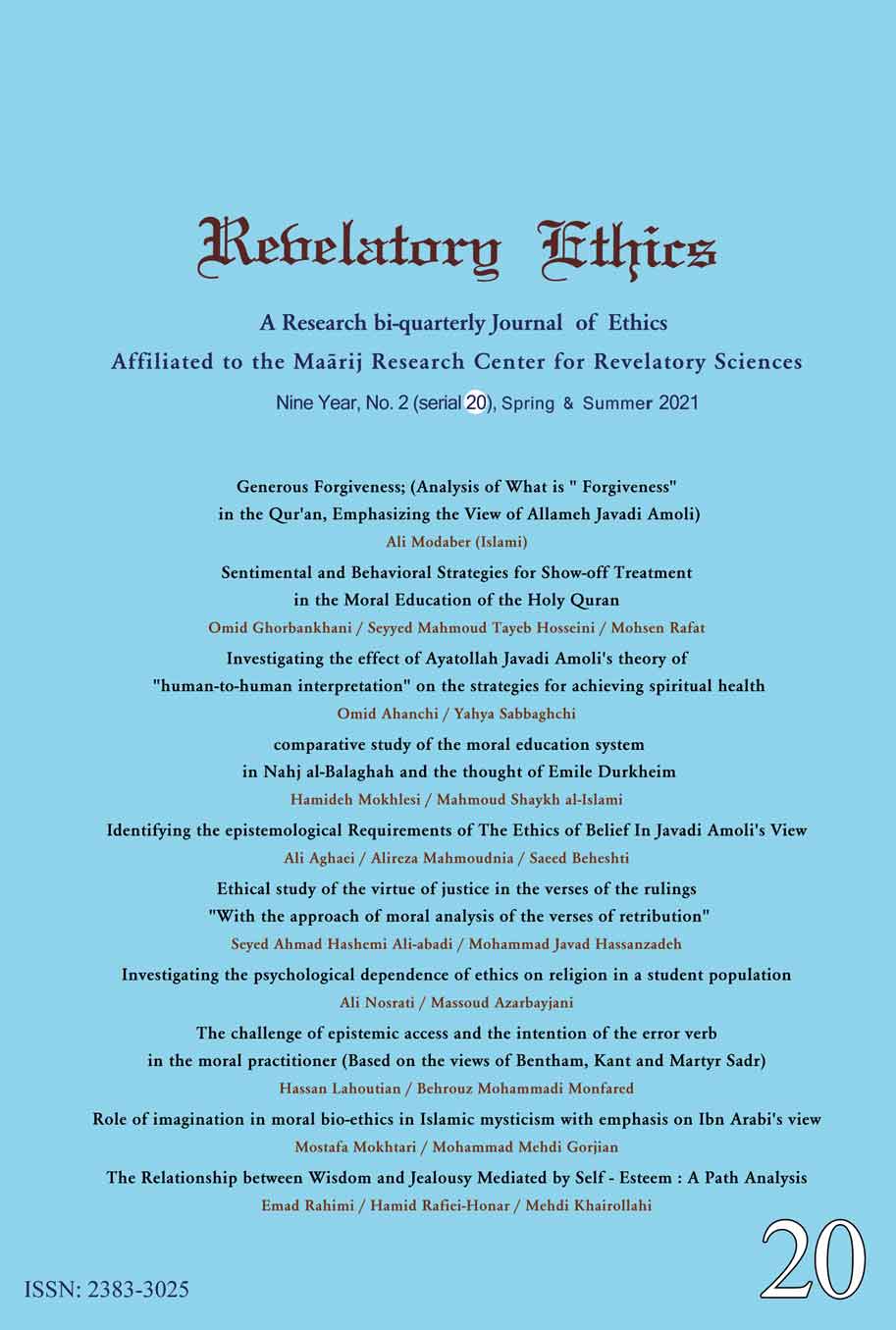
Revelatory Ethics

Revelatory Ethics

Number of Volumes 16
Number of Issues 39
Number of Articles 277
Number of Contributors 363
Article View 314,367
PDF Download 182,899
View Per Article 1134.9
PDF Download Per Article 660.29
Number of Submissions 1,222
Acceptance Rate 16
Time to Accept (Days) 135

Revelatory Ethics is a double-blind, peer-reviewed publication which is published by Maarej Research Institute of Revelation Sciences. This journal follows the Committee on Publication Ethics (COPE) and complies with the highest ethical standards by ethical laws. All submitted manuscripts undergo an extensive peer review by subject matter experts after being verified as authentic by a similarity check  (Samimnoor). 


Journal Features
  • Title: Revelatory Ethics
  • Country of Publication: IRAN
  • Date of First Publication: 2011
  • Frequency: Quarterly
  • Language: Persian/English Abstract
  • Publication fee:  No
  • Open Access: Yes
  • Review Process: Double-blind peer review
  • Contact e-mail: israethics@gmail.com


Current Issue: Volume 16, Issue 2, Summer 2026, Pages 9-168 

Publication Information

Indexing and Abstracting

Keywords Cloud

  • Ethics
  • ethics
  • Islamic ethics
  • Javadi Amoli
  • Ayatollah Javadi Amoli
  • Islam
  • morality
  • Virtue Ethics
  • Religion
  • Quran
  • Moral education
  • Law
  • Intellect
  • Islamic psychology
  • Deontology
  • Jurisprudence
  • Holy Quran
  • Consequentialism
  • Christian ethics
  • Justice
  • \"
  • normative ethics
  • forgiveness
  • Applied Ethics
  • Motivation
  • Mulla Sadra
  • Farabi
  • The Holy Quran
  • pleasure
  • Islamic sources
  • ethical education
  • Happiness
  • perfection
  • reason
  • wisdom
  • moral motivation
  • moral virtues
  • Professional Ethics
  • Naturalism
  • Islamic education
  • Spiritual Health
  • Imam Khomeini
  • Martyr Sadr
  • love
  • parental control
  • Asharites
  • Gender
  • Sacrifice
  • Ethical Concepts
  • psychology of ethics
  • asceticism
  • nature
  • worship
  • cognition
  • Psychological
  • religious ethics
  • \"Moral Goodness and Badness\"
  • Moral Intelligence
  • Principles
  • ethical value
  • Ethical Values
  • Ethical Proposition
  • virtue
  • social relations
  • Motahhari
  • Questionnaire
  • Moral Value
  • Piety
  • intention
  • Moral realism
  • Practical Wisdom
  • Educational implications
  • Environmental ethics
  • Authority
  • Behavior
  • social ethics
  • Allameh Javadi Amoli
  • rationality
  • The basics of education
  • Ultimate Perfection
  • Quranic Ethics
  • Moral Psychology
  • divine proximity
  • Contemporary World
  • Epistemology
  • Moral Development
  • psychology
  • Free Will
  • Peace
  • content analysis
  • Consumer Behavior
  • faith
  • Human dignity
  • Nahj al-Balaghah
  • animation
  • slamic criminal law
  • Ash‘arite
  • Key word
  • Jalali Ethics
  • Self-Destruction
  • Key words: human nature
  • ethical theology
  • individual mysticism
  • Good
  • Inherent Rational Goodness and Badness
  • (Muslim and non-Muslim) Trainers
  • previous accumulation
  • Ethics of Servitude
  • \"؛ Javadi Amoli
  • capital increase
  • Religion and the Environment
  • ethical consequences
  • doubtful situations
  • Ethics of the Earth
  • Mankind
  • Man balagh traditions
  • Loyalty
  • Imaginative Faculty
  • old age
  • intrinsic and other values
  • parenting
  • Moral Scale
  • beauty and ugliness
  • norm
  • intimacy
  • Theomorphy
  • criterion
  • moral principles
  • Cognitive Map
  • Surah al-Baqarah
  • Karma
  • Moral Deontology
  • Ibn Arabi
  • ,Javadi Amoli
  • the afterlife
  • Tusi
  • Ayātollah Javadi Amoli
  • computer games 
  • Treatment of Attitude
  • Quranic Conceptualization
  • Return to the Self
  • Hazrat Muhammad
  • principle of moral jurisprudence
  • Critique of religions
  • Bandura
  • school of yoga
  • fi
  • Neorealism
  • light
  • IT Ethics
  • Ayatollah Javadi
  • Self-alienation
  • police society-oriented
  • Efficiency
  • correction
  • Death
  • just retribution
  • deontologism
  • obstacle of experiencing joy
  • facilitating relationships
  • Ethical Pragmatism
  • Mafatih al-Hayat
  • Meaning of life
  • epistemological foundation
  • the revelation system of education
  • Friendship
  • Moral Uncertainty
  • People
  • History of Moral Thought
  • Avicenna
  • Health of belief
  • Bentham
  • assessing moral values
  • traveler of spiritual path
  • Chastity
  • Secular Ethics
  • semantic and cognitivist
  • charity
  • نظریه‌های اخلاقی
  • self-reproaching soul
  • Security
  • Function of faith
  • will
  • philosophy
  • Inherent and intellectual
  • Criteria for ethics
  • Digital Education
  • Hosts of Reason
  • Practical Commitment
  • al-Farabi
  • Social Engagement
  • Modesty
  • Epistemic relativism
  • self-deception
  • spiritual vices
  • Genesis
  • Mesbah Yazdi
  • siblings
  • virtuous subject
  • Axiom