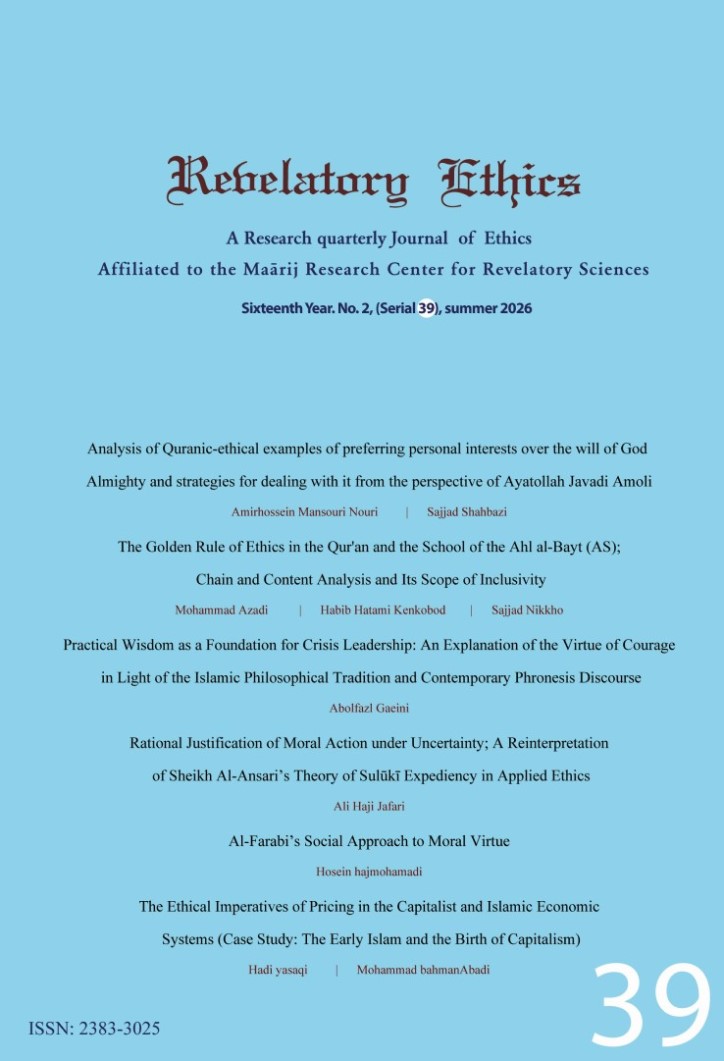
Document Type : Original Article
Highlights
Extended abstract
One of the fundamental tendencies in human nature is the desire for perfection; The desire for perfection is ultimately directed to the holy essence of the Most High; Because the good that exists in the beings and affairs of the world is a relative good and the existence of the Almighty is considered absolute good (Javadi Amoli, 2008, vol. 8, p. 311)
Some people find their perfection in absolute poverty in relation to God Almighty - true perfection - and others know themselves in a position of independence from God Almighty - illusory perfection. For example, the Holy Quran says: "Indeed, Pharaoh was arrogant and haughty in the land (Egypt) (Qasas, 4; Fayd al-Islam Isfahani, 1378, Vol. 2, p. 768)"; Pharaoh's arrogance and haughtiness reaches a point where he says: "I have not known for you any god other than Me (Qasas, 38)"; From this noble verse, it can be understood that Pharaoh found his perfection in a position of independence from God Almighty. This understanding represents a type of "illusory perfection" that stems from self-conceit and self-interest.
This article will attempt to find an answer by studying and collecting verses that point to radical examples of the preference of personal interests over divine will, delving into the interpretative and philosophical theories of Ayatollah Javadi Amoli, and analyzing the findings. This was the same motivation that led Pharaoh to rely on her evil nature to seek superiority over everyone and to prefer illusory perfection to true perfection - the realization of absolute poverty in relation to God Almighty.
Description and analysis of verses pointing to instances of preference for personal interests over divine will
The existential status of man in the Holy Quran is explained at two fundamental levels:
The first level: It concerns the identity of man. In this level, in contrast to the logicians’ definition of man as a “speaking animal,” the Quran considers man to be “living, divine,” meaning a living being whose life is manifested in the divine, which is the melting in the manifestation of divinity, and whose purpose is to move toward the manifestation of the beautiful names of God (Javadi Amoli, 2002, p. 37).
The second level: It is dedicated to the manner in which the divine essence of man (i.e., life and divine) is fecundated and the path to achieving human perfection. This level also includes examining the facilitating conditions (ease) and the difficult obstacles (difficulty) along this path, as well as identifying the companions and bandits of this path (Javadi Amoli, 2002, p. 37-38).
Description of verses pointing to instances of prioritizing personal interests over the will of God
A) Supremacy: According to the authors, the term "supremacy" is the first manifestation of preferring personal interests over divine will.
Some commentators believe that Pharaoh, through his superiority and misuse of power, divided the people into different groups and deliberately created discord and separation among them so that the descendants of the Israelites would be destroyed (Tabatabai, 1374, vol. 16, pp. 8-9; Tabarsi, 1415, vol. 7, pp. 413-414 and Makarem Shirazi, 1374, vol. 16, pp. 11-12).
B) Arrogance: Arrogance is another manifestation that indicates the preference of personal interests over the will of God. The following verses can be cited as evidence:
C) Preferring: this world over the hereafter: The title of preferring this world over the hereafter is another manifestation that indicates the preference of personal interests over the will of God.
After systematically describing the verses related to the preference of personal interests over divine commands from the perspective of the Holy Quran, it is appropriate to analyze the verses and their implications on how personal interests are preferred over divine commands.
It is worth noting that God Almighty has always opened the door of His mercy even to the most wicked of His servants; but man’s lust for power and self-interest, which is rooted in selfishness, self-conceit, and arrogance, prevents man from seeing this mercy and taking steps on the path of true perfection – absolute poverty towards the Almighty. Human perfection is not realized in the establishment of “ego” but in servitude, submission to the divine command, which is the result of understanding poverty in essence and absolute need towards the Almighty (Javadi Amali, 1372, vol. 1, p. 409).
Analysis of verses pointing to instances of prioritizing personal interests over divine will
1. The desire for superiority causes neglect of the truth of existence in the face of the world's deception.
One of the manifestations of preferring personal interests over divine commands is man's desire for superiority. This factor causes him to neglect true perfection.
2. Arrogance causes greed and greed for the world.
One of the manifestations of preferring personal interests over divine commands is arrogance. Having arrogance is analyzed in the verses of the Holy Quran by describing the course of Satan. When God ordered Satan to prostrate to Adam, four major mistakes caused his rebellion against the truth:
Self-righteousness and incorrect standardization
Arrogance in the face of God's command.
Blind attachment to one's own thoughts.
Preferring one's own desires over obedience to God.
3. Preference for worldly interests causes instability in the criteria for decision-making and action:
One example of preference for personal interests over divine commands is the preference for worldly interests over the Hereafter, which causes instability in human criteria for decision-making and action.
A solution to deal with the preference of personal interests over divine will.
A) Understanding and awareness:
The best art for a human being is his wisdom and intellect. It is enough in the virtue of intellect that even those who do not have it try to introduce themselves as wise and intelligent (Javadi Amoli, 2009, p. 140); Human understanding and awareness of the truth of the world are fundamental.
B) Faith and Jihad:
Another way to combat the preference of personal interests over the will of God is faith and jihad; in Surah As-Saff, which was mentioned earlier, God mentions the most important human capital as human life and property, and man sees his benefit and advantage in preserving them, and this is considered a kind of illusory perfection.
C) Self-sacrifice in the way of God:
Another way to deal with the preference of personal interests over the will of God is to sacrifice oneself in the way of God.
List of the Most Important Sources
1. in persian, Javadi Amoli, Abdullah, 2009, Tasnim Commentary, Israa Publishing Center, Qom, Iran.
2. in persian, Javadi Amoli, Abdullah, 2002, The Face and Character of Man in the Quran, Israa Publishing Center, Qom - Iran.
3. in persian, Javadi Amoli, Abdullah, 1993, Sharia in the Mirror of Knowledge, Raja Cultural Publishing Center, Marvi Press.
4. in Arabic, Tabataba'i, Muhammad Hossein, 1995, Al-Mizan fi Tafsir al-Quran, Ismailis.
5. in Arabic, Sheikh Tabarsi, 1415-1995, Majma’ al-Bayan fi Tafsir al-Quran, Al-Alamy Publications Institute, Beirut - Lebanon, first edition.
6. in persian, Makarem Shirazi, Nasser, 1995, Tafsir Nimnu, Dar Al-Kutb Al-Islamiyya Publishing House, Tehran, 32nd edition.
7. in persian, Faiz-ul-Islam Isfahani, Ali Naqi, 1999, Translation and Commentary of the Holy Quran, Faqih Publishers, Tehran - Iran.