Document Type : Original Article
Highlights
Extended abstract
Introduction
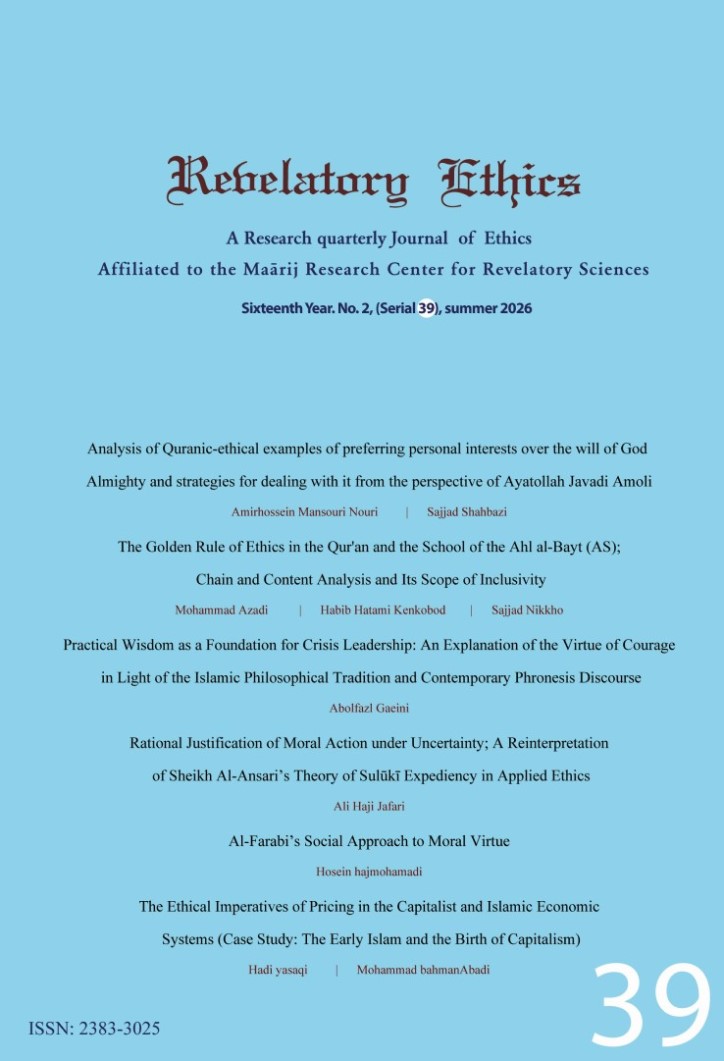
This article presents a comprehensive investigation into the ethical principle known as the "Golden Rule" within the School of the Ahl al-Bayt (AS) in Shi'a Islamic tradition. The Golden Rule prescribes that one should desire for others what one desires for oneself and dislike for others what one dislikes for oneself. Employing a rigorous ijtihad-based methodology grounded in the epistemological and jurisprudential approach of the Ahl al-Bayt (AS) school, the research examines four primary questions: (1) the evidentiary value of Qur'anic, hadith, and rational proofs from chain-of-transmission (isnad) and textual-content (dalalah) perspectives; (2) whether the rule pertains to internal emotional dispositions, external behavioral actions, or both; (3) the inferred legal-ethical ruling—obligatory (wajib) or recommended (mustahabb); and (4) whether the rule applies exclusively to Muslims or encompasses all of humanity.
Research Methodology
The study employs an ijtihad-based approach consistent with Ahl al-Bayt (AS) methodological principles across four stages: comprehensive data collection from primary Shi'a hadith sources including Al-Kafi, Wasail al-Shi'a, Mustadrak al-Wasa'il, Nahj al-Balagha, and Tuhaf al-'Uqul; rigorous isnad authentication utilizing established rijal works such as Rijal al-Najashi and Mu'jam Rijal al-Hadith; textual-content analysis applying classical hermeneutical rules; and synthesis and conclusion.
Key Findings
Evidentiary Analysis
Three types of proofs are identified and categorized:
Qur'anic Evidence: While no verse explicitly states the Golden Rule verbatim, three verses are examined—Surah al-Rahman (55:60), Surah al-Nur (24:22), and Surah al-Mutaffifin (83:1-3). The analysis concludes these verses lack direct correspondence and at best demonstrate limited relevance, with al-Mutaffifin restricted to financial transactions.
Hadith Evidence: Approximately twenty to thirty narrations from Shi'a sources are identified and authenticated. Key narrations include the Sahihah of Ibrahim ibn 'Umar al-Yamani, the Sahihah of 'Abdullah ibn Muskan—both with wholly reliable chains—the narration of Mu'alla ibn Khunays, and the comprehensive formulation in Nahj al-Balagha, Letter 31, where Imam Ali (AS) instructs Imam Hasan (AS): "My son! Make yourself a scale between yourself and others. So love for others what you love for yourself, and dislike for others what you dislike for yourself."
Rational Proof: Independent reason affirms that humans share a common essence and dignity, demanding mutual respect and reciprocal treatment unless exceptions are justified by sound evidence.
Scope of the Golden Rule
Comprehensive Ethical Criterion: The research establishes that the Golden Rule functions as a comprehensive ethical standard grounded in the transcendent reality (haqiqah nafs al-amriyyah) of inherent human dignity (karamah). It is not merely a collection of particular ethical rules but a foundational principle rooted in the philosophical premise that all humans share a unified reality and common dignity. This resolves potential objections regarding subjective preferences, as the rule is normatively grounded in objective human dignity rather than arbitrary personal inclinations.
Unity of Affirmative and Negative Formulations: The analysis demonstrates that the positive formulation ("love for others what you love for yourself") inherently encompasses the negative formulation ("dislike for others what you dislike for yourself"), as seeking benefit and avoiding harm are both integral to human preference, unified in the principle of reciprocal measure.
Internal and Behavioral Dimensions: Two interpretive possibilities are examined: restriction to emotional dispositions versus application to behavioral actions. Four textual witnesses support the behavioral interpretation: the narrations of Abi al-Bilad, Shaykh al-Shami, Sukuni, and the comprehensive Nahj al-Balagha formulation. The research concludes the rule encompasses both dimensions; even if primarily restricted to internal states, analogical reasoning (qiyas al-awlawiyyah) extends the obligation to behavioral actions, and the behavioral interpretation necessarily includes internal loving as a prerequisite.
Obligation versus Recommendation: The study proposes a detailed "Scale Theory" resolving tensions between proof-texts suggesting obligation versus recommendation. Three possibilities are examined: absolute obligation, absolute recommendation, and differentiation according to expectation. The preferred view, based on Imam Ali's instruction to "make yourself a scale," establishes that the rule's force corresponds to the quality of expectation one has from others. When an expectation is essential and obligatory—such as refraining from oppression, insult, or harm—the rule indicates obligation (wujub). When an expectation is merely praiseworthy—such as lending money or offering courteous treatment—the rule indicates recommendation (istihbab). This nuanced theory resolves apparent contradictions in the evidence.
Universal Human Scope: The study innovatively categorizes evidence into three tiers: evidences specific to believers (Mu'minin), evidences specific to Muslims, and universal evidences employing terms such as "people" (al-nas) and "others" (ghayrika). The research establishes that the Golden Rule extends to all human beings by virtue of shared human dignity (al-karamah al-insaniyyah), as explicitly affirmed in Imam Ali's instruction to Malik al-Ashtar: "They are either your brother in religion or your equal in creation."
Conclusion
The research concludes that the Golden Rule in the School of the Ahl al-Bayt (AS) is substantiated by multiple authentic chains of transmission and rational proof, forming a comprehensive ethical criterion rooted in the objective reality of shared human dignity. The rule encompasses both internal emotional dispositions and external behavioral conduct, applies universally to all humanity rather than being restricted to co-religionists, and yields legal-ethical rulings that vary according to the quality of mutual expectation—obligatory for essential reciprocal rights and recommended for praiseworthy acts of excellence. This nuanced understanding positions the Golden Rule as a foundational principle for social ethics, jurisprudence, and the development of a comprehensive ethical framework grounded in revelation and prophetic guidance.
Key Contributions
1.Comprehensive isnad authentication of all relevant narrations across Shi'a sources
2.Systematic analysis of the rule's extension to behavioral action with four textual witnesses
3.Novel "Scale Theory" differentiating between obligation and recommendation
4.Tripartite categorization of evidence according to scope of inclusiveness
5.Philosophical grounding of the rule in the objective reality of human dignity
Major References
1. The Noble Qur'an
2. Al-Kulayni, Muhammad ibn Ya'qub. (1407 AH). Al-Kafi (4th ed.). Tehran: Dar al-Kutub al-Islamiyyah. (in Arabic)
3. Al-Hurr al-'Amili, Muhammad ibn al-Hasan. (1409 AH). Wasail al-Shi'ah. Qom: Mu'assasat Al al-Bayt (AS). (in Arabic)
4. Al-Sharif al-Radi, Muhammad ibn Husayn. (1414 AH). Nahj al-Balaghah (Subhi Salih edition, 1st ed.). Qom: Hijrat. (in Arabic)
5. Kant, I. (1997). Groundwork of the Metaphysics of Morals. Cambridge: Cambridge University Press.
6. Neusner, J. (Ed.). (2008). The Golden Rule: The Ethics of Reciprocity in World Religions. Cromwell Press.